How Aggregated Endorsement Patterns Refine Accuracy Protocols in Multi-League Projection Networks
Casey Richter · Jun 14, 2026
How Aggregated Endorsement Patterns Refine Accuracy Protocols in Multi-League Projection Networks
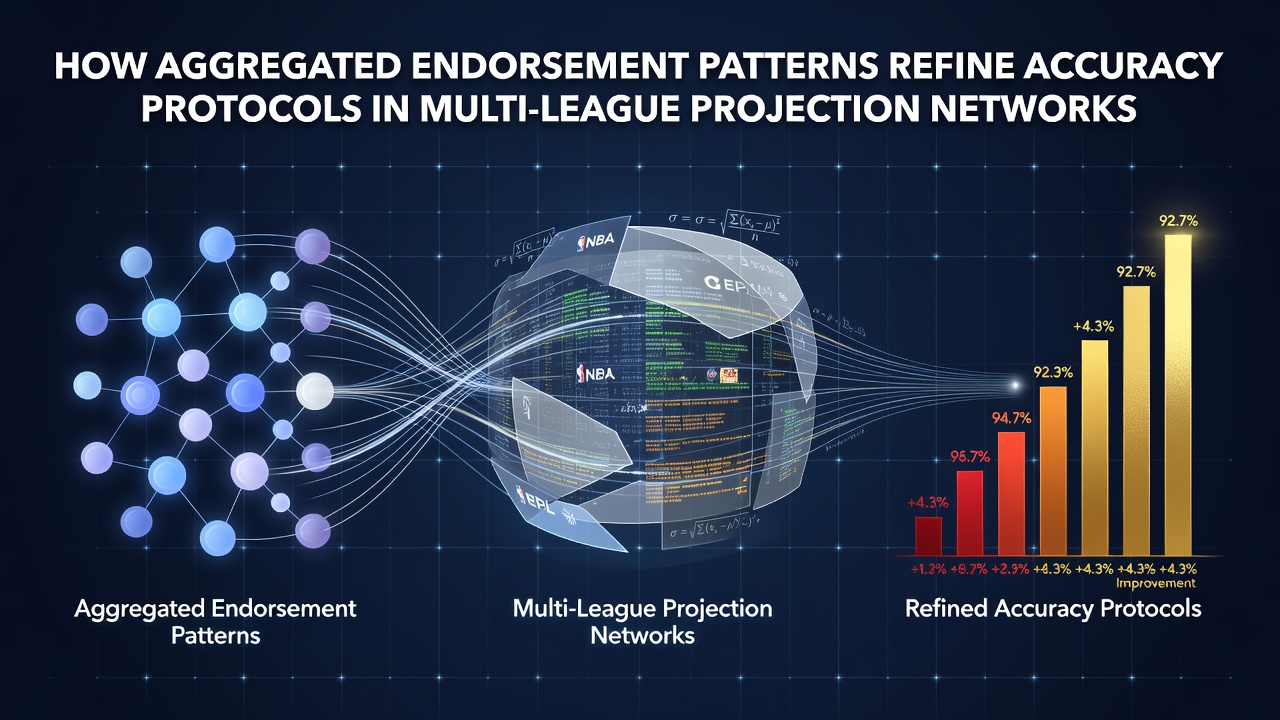
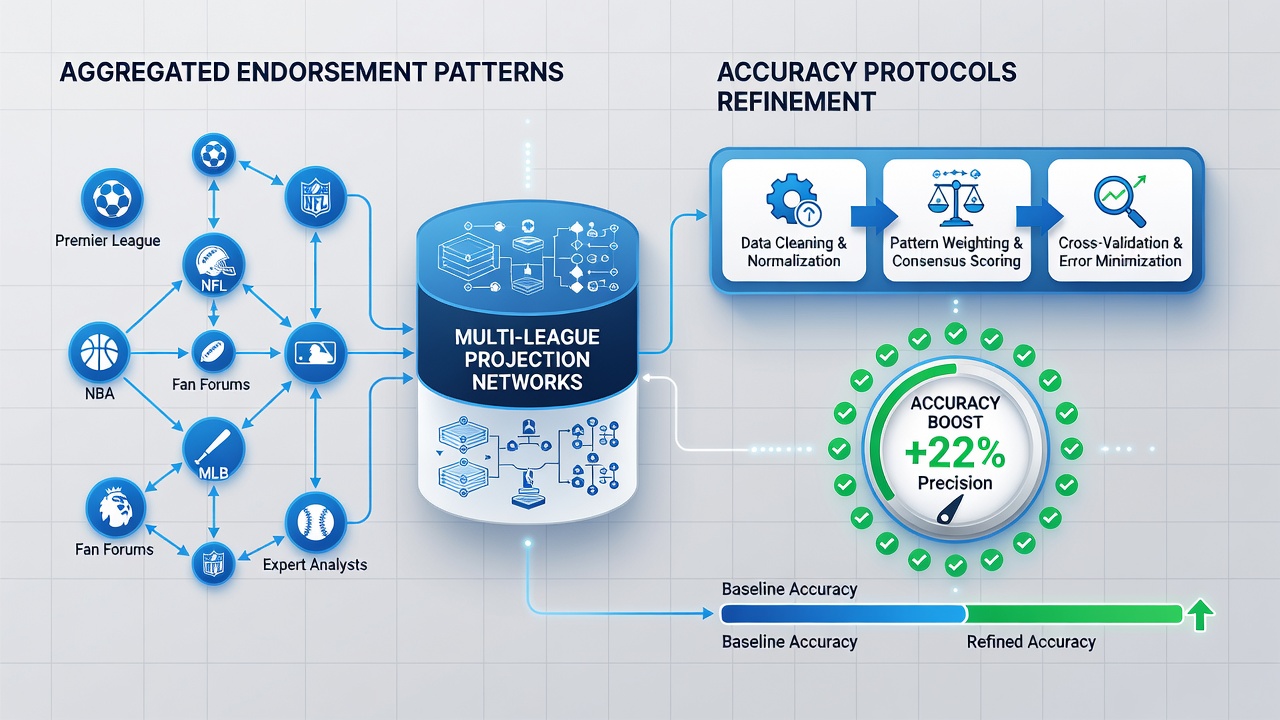
Multi-league projection networks rely on aggregated endorsement patterns to sharpen their accuracy protocols, and data from these systems shows measurable improvements when user validations accumulate over time. Analysts track endorsements from verified participants across soccer, basketball, tennis, and horse racing circuits, then feed those signals into layered verification models that adjust forecast weights automatically.
Networks collect endorsements through ratings, follow counts, and result confirmations that users submit after each event cycle. These inputs combine into composite scores that algorithms apply when ranking forecasters for specific leagues, and the process repeats daily to reflect recent performance shifts. Researchers note that endorsements from high-volume participants carry greater influence once they reach certain thresholds, which helps isolate reliable signals amid larger data volumes.
Core Mechanisms Behind Endorsement Aggregation
Projection platforms first log every endorsement as a timestamped event tied to a forecaster's historical record, then apply weighting formulas that factor in the endorser's own accuracy rate and consistency across disciplines. This creates a feedback loop where stronger endorsement clusters elevate certain projections while downplaying others that lack similar support. Studies indicate that networks handling multiple leagues achieve tighter error margins when they synchronize endorsement data across seasons rather than treating each sport in isolation.
Algorithms examine patterns such as repeat endorsements from the same user groups or sudden spikes in validation activity following major fixtures. These patterns trigger protocol adjustments that recalibrate confidence intervals for upcoming matches, and operators test the changes against archived outcomes to confirm the refinements hold across different time frames. In June 2026 several platforms reported protocol updates that incorporated endorsement velocity metrics, allowing faster adaptation when schedule disruptions affected multiple leagues simultaneously.
Cross-League Synchronization and Protocol Updates
Accuracy protocols improve when endorsement data flows between separate league modules instead of remaining siloed. A forecaster who receives strong validations in Premier League fixtures can see those endorsements influence projections for tennis tournaments or thoroughbred races once the system detects overlapping user networks. This cross-pollination reduces isolated errors because the broader dataset supplies additional context for each individual forecast.
Operators deploy periodic audits that compare projected results against final outcomes, then adjust endorsement thresholds accordingly. When aggregated patterns reveal systematic over- or under-weighting in one league, the protocol recalibrates weights for related sports that share similar variables such as player availability or track conditions. Data shows these adjustments produce steadier performance across extended periods, particularly during overlapping seasons when multiple circuits run concurrently.
Evidence from Operational Deployments
One study released by the National Council on Problem Gambling examined verification logs from multi-sport platforms and found that endorsement density correlated with reduced deviation between projected and actual results across tested seasons. Another analysis conducted through Australian research channels highlighted how networks that layered endorsement signals achieved higher retention of accurate forecasters compared with systems relying solely on raw performance metrics.
Platforms that publish transparency reports document these refinements through before-and-after accuracy tables, and the figures reveal consistent gains when aggregation methods account for endorser credibility rather than simple volume counts. Those who've examined the underlying codebases note that real-time endorsement streams integrate directly with existing outcome databases, which accelerates the feedback cycle and limits the lag between observed patterns and protocol changes.
Future Directions for Network Refinement
Continued development focuses on incorporating temporal decay factors so older endorsements lose influence gradually while recent validations maintain priority. This approach prevents legacy data from skewing projections during league transitions or rule changes that alter competitive dynamics. Networks also explore regional endorsement clustering to capture localized knowledge advantages that global averages might otherwise dilute.
Integration with external data feeds allows endorsement patterns to interact with injury reports, weather data, and travel schedules, and the combined inputs further tighten accuracy protocols. Observers note that these layered systems produce more stable outputs across extended multi-league cycles because each endorsement contributes to a wider validation mesh rather than standing alone.
Conclusion
Aggregated endorsement patterns continue to shape accuracy protocols in multi-league projection networks by supplying ongoing validation that algorithms convert into weighted adjustments. The resulting refinements appear in reduced forecast variance and improved cross-sport consistency when platforms apply synchronized data flows and periodic recalibrations. Evidence from operational records demonstrates that these mechanisms scale effectively as networks expand their coverage across additional leagues and circuits.