Cross-Referenced User Feedback Loops Refining Projection Models Across Varied Competitive Circuits and Leagues
Casey Richter · Aug 2, 2026
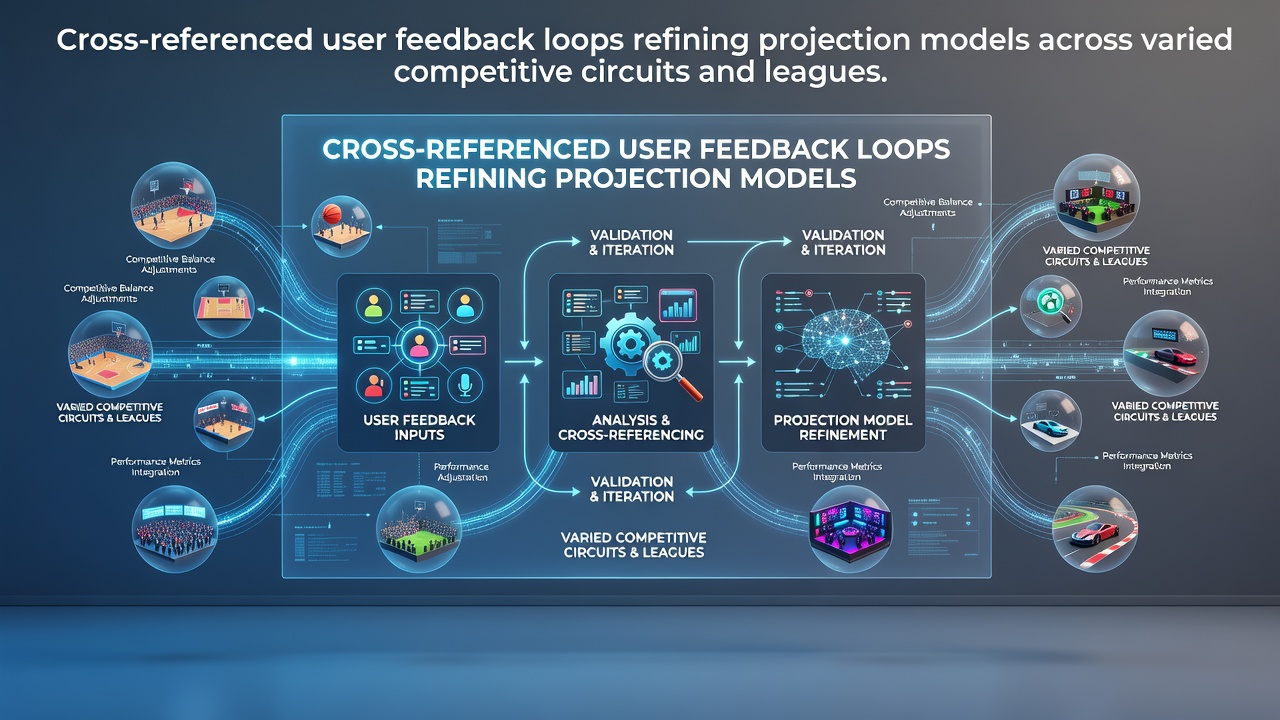
Cross-Referenced User Feedback Loops Refining Projection Models Across Varied Competitive Circuits and Leagues
Projection models in competitive sports and racing rely on continuous data streams that include results from league matches, circuit events, and participant statistics, and user feedback loops supply additional layers of validation that help adjust those models over time. Observers note that platforms handling forecasts across football leagues, basketball conferences, and equine circuits collect input from verified users who submit observations on model outputs, then cross-reference those inputs against actual outcomes to identify patterns requiring refinement.
Researchers at institutions tracking athletic performance data have documented how feedback arrives in structured formats, such as accuracy ratings tied to specific match conditions or track surfaces, and systems aggregate these reports before comparing them to independent datasets. In August 2026, several multi-sport advisory networks reported measurable shifts in model parameters after incorporating feedback collected during the prior European football season and North American summer racing meets, with adjustments focused on variables like weather impacts and schedule density.
Mechanics of Cross-Referencing in Projection Systems
Cross-referencing begins when feedback from one circuit reaches validation against records from unrelated leagues, allowing analysts to detect whether a suggested adjustment holds across contexts. For instance, a basketball totals model might receive user notes on injury timing that later align with patterns observed in soccer fixture disruptions, prompting shared parameter tweaks. Those who maintain these systems emphasize that the process requires matching timestamps and event identifiers so that isolated comments do not skew broader calibrations.
Data from Canadian university studies on sports analytics shows that platforms applying cross-referenced loops reduced projection variance by measurable margins when inputs spanned both team sports and individual racing formats. The same studies indicate that August 2026 updates incorporated feedback from Australian thoroughbred events to recalibrate North American gridiron forecasts, illustrating how geographic and seasonal diversity strengthens the reference base.
Application Across League and Circuit Environments
Football leagues generate dense match data that users often compare against model probabilities, while racing circuits contribute variables tied to track conditions and equine performance histories. Feedback loops that draw from both domains allow model maintainers to test whether refinements developed in one setting transfer effectively to the other. Experts tracking these exchanges point out that verification protocols now include automated checks that flag inconsistencies between user-submitted observations and official results before any parameter change occurs.

Industry reports from the Australian Sports Commission highlight similar integration efforts in which user networks covering flat racing and basketball prop projections share validation layers. These reports note that cross-referenced data collected through the first half of 2026 produced refinements in handling schedule compression effects, a factor common to both compressed league calendars and multi-stage racing meets. The approach avoids single-source bias by requiring confirmation from at least two distinct competitive environments before model weights receive updates.
Verification Protocols and Long-Term Model Stability
Verification protocols rely on timestamped user submissions paired with outcome records, creating audit trails that later support longitudinal analysis. Platforms operating across international circuits have adopted these protocols to maintain consistency when leagues transition between seasons or when racing circuits move between surfaces. Those studying the resulting datasets observe that feedback volume tends to increase during high-stakes periods, such as playoff rounds or championship circuits, supplying richer material for cross-referencing.
According to findings published by the National Collegiate Athletic Association analytics division, models refined through multi-circuit feedback demonstrated improved calibration across both team and individual event types during the 2025-2026 academic year. The same findings reference August 2026 data releases showing continued iteration cycles that incorporated user observations from summer league play and off-season racing events, further tightening projection intervals.
Conclusion
Cross-referenced user feedback loops continue to serve as a primary mechanism for updating projection models that span varied competitive circuits and leagues. The documented processes combine user observations with independent outcome data, apply verification steps that require multi-context confirmation, and produce parameter adjustments tracked across multiple athletic disciplines. Records maintained by academic and industry sources indicate that these loops have supported measurable calibration improvements through 2026, particularly when feedback originates from geographically and seasonally distinct events.